Systems of Government, the beating heart of nations, comes in various forms, each one having its own rhythm and character. Traveling across the world’s continents, we immerse ourselves in fascinatingly woven government policies, each telling the story of political dynamics and social norms. From the stable presidential democracies of the United States to the constitutional nuances of Europe and the landscapes of Asia, Africa, Oceania and North America, the diversity of our planet’s politics is on full display

Join us in a fascinating exploration of these global polities, with regimes as diverse as the cultures that serve them, shaping the destinies of billions of people and mapping the fabric of history.
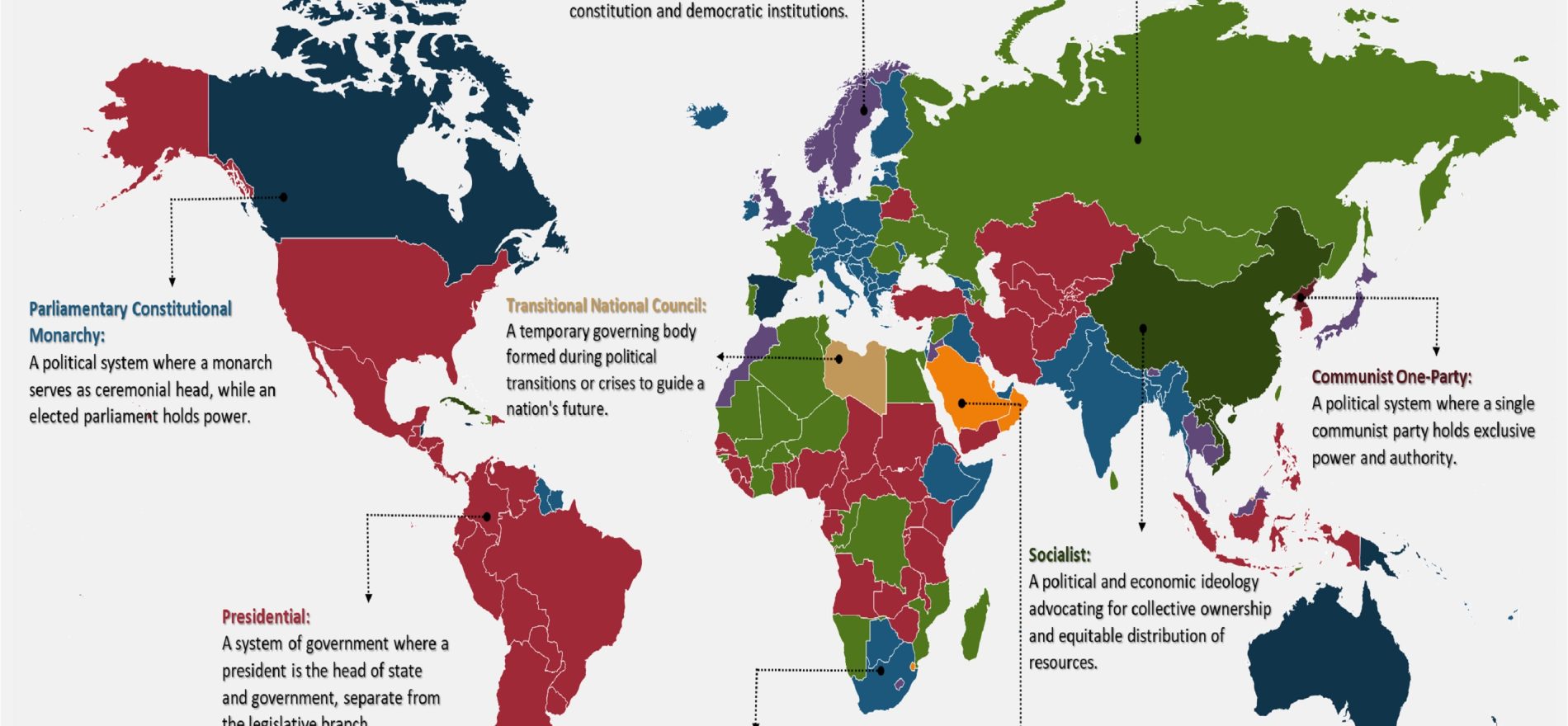
In the fabric of governance, we find 196 distinct threads that shape how nations are governed. As we delve into this landscape, we discover a captivating mosaic. While presidential systems stand out as the most common, with 64 nations adopting this leadership style, parliamentary systems come in second with 55 countries.

Constitutional Monarchies offer a mix of tradition and democracy in 23 nations, while another 13 embrace Parliamentary Constitutional monarchy. The allure of socialism finds favor in 4 places, while 5 countries hold Absolute Monarchy. A lone Communist One-Party system persists, and transitional national councils pave the way in one nation. This symphony of governance showcases the intricacy of our world—a harmonious blend where each nation’s unique tune contributes to humanity’s diverse political journey that is ever-evolving.
Taking a closer look at the data when broken down by continent, we begin to see a clear global trend in government Systems:

Systems of Government : Africa
Presidential system is the most common in 54 African countries; 29 countries follow this system and 54% of the continent’s governments Presidential system followed by 16 countries (29%) revealed that there is a great presence of a Semi-Presidential. The remaining states use different systems including parliamentary (9%) and Constitutional Monarchy (4%), Absolute monarchies, and Transitional National Council Represent (2%) each.
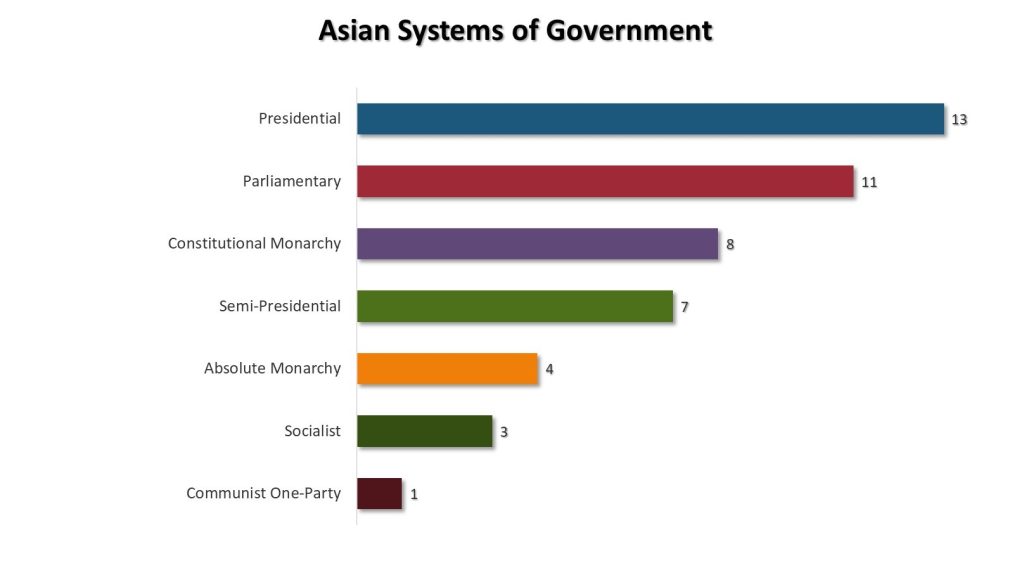
Systems of Government : Asia
Asia has a diverse mix of government systems. The largest category is the Presidential system, with 13 states (28%), followed by the Parliamentary system with 11 states (23%). Constitutional Monarchy and Semi-Presidential system make up around 17% and 15% of the continent, with 8 and 7 states, respectively. There are now fewer Absolute Monarchies (9%), Socialist systems (6%), and one country ruled by One-Party Communist regime (2%).

Systems of Government : Europe
Parliamentary systems are common in Europe, with 59% of the continent’s governments, and 27 countries following this model. In particular, Constitutional Monarchies (22%) and Semi-Presidential systems (13%). Presidential and Parliamentary Constitutional Monarchy each represent 4% and 2% of European governments systems.

Systems of Government : North America
There is a strong Presidential government system (39%) in North America, 9 out of 23 states follow Parliamentary Constitutional Monarchy (31%) are also important, with 7 states this method is used. The remaining states adopt systems including Parliamentary (13%), Constitutional Monarchy (9%), Semi-Presidential and Socialist Respectively 4% Each.
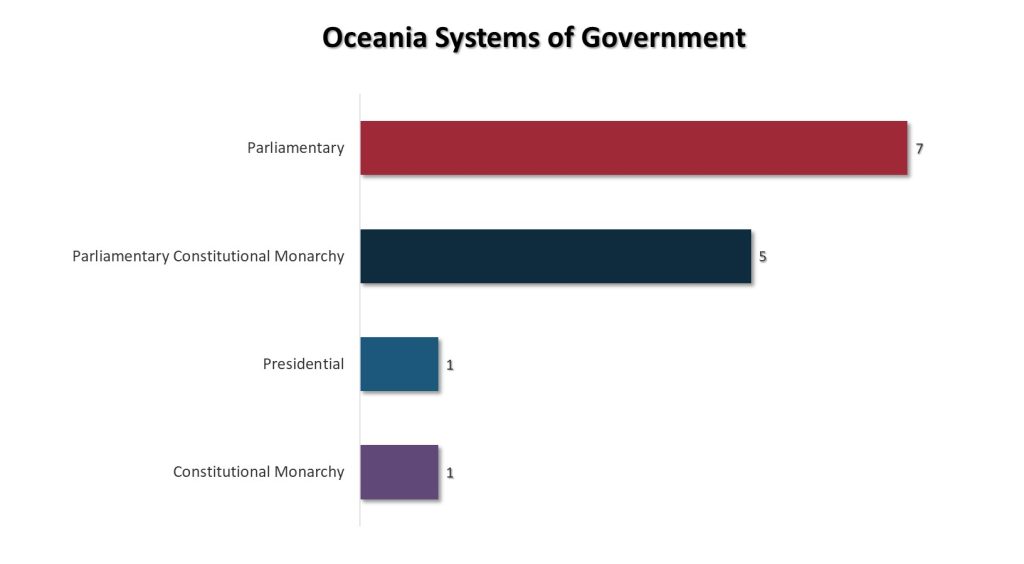
Systems of Government : Oceania
Oceania has Parliamentary system (50%), Parliamentary Constitutional Monarchy (36%), a small representation of Presidential (7%) and Constitutional Monarchy (7%) governments and it should be noted that there are few states this continent compared to other continents.
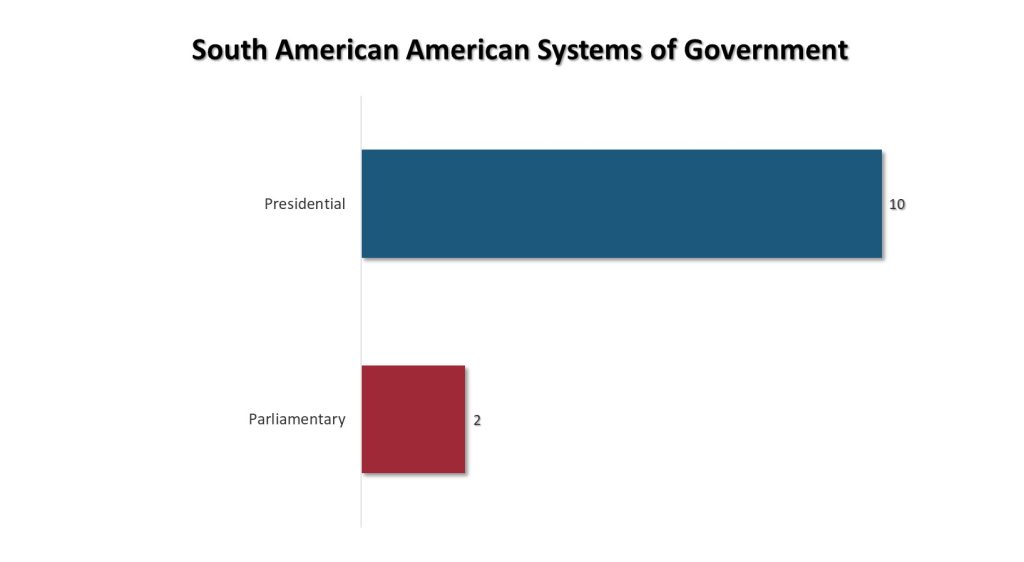
Government Systems : South America
Most South American states established by Presidential system (83%), with 10 out of 12 states following this model. The other two states opted for a Parliamentary system which represent 17% of South America Continent.
Through data analysis highlights the sophistication of government policies across continents, revealing a mosaic of political ideologies and policies. Africa and South America are governed by presidential systems, Europe favors parliamentary models, and Asia exhibits a mix of strategies. These differences underscore the dynamics of governance around the world, making each continent’s political environment unique.
Notes
- The information and analysis presented in this article are not necessarily representative of specific geographic areas or populations.
- This analytical article is intended for research, education and knowledge sharing purposes only.
- Please note that the data used in this analysis may change over time.
Process is short
- We collected data using Excel’s web data collection tool.
- To ensure accuracy, we used Python with Pandas and NumPy libraries for data cleaning and preprocessing.
- To create insightful visual presentations, we used a combination of Excel and Power BI.
- For Data Analysis we use Power query and Power Pivot in Excel.
- Strict quality checks were carried out at every stage of data processing to maintain data integrity and reliability.
- Collaborative efforts were undertaken with experts in the field to ensure the accuracy and relevance of the data and analyzes presented in this article.
For those interested in more information and research please visit My GitHub Profile and Analyse Info Web, where comprehensive data, Analysis, reports are available.